
Two languages of the soul
In an age often marked by religious misunderstanding and superficial comparisons, Orthodox iconography and Islamic calligraphy offer a rare opportunity for a deeper conversation. They represent two of the most sophisticated spiritual languages ever developed around the Mediterranean, yet they are seldom studied together. While one is centered on the sanctified image and the other on the sanctified word, both emerge from centuries of prayer, contemplation, discipline and theological reflection. Bringing iconographers, calligraphers, theologians, historians and spiritual practitioners into dialogue does not mean erasing the profound differences between Christianity and Islam. On the contrary, it means understanding those differences more deeply while discovering unexpected common ground.
Joint workshops, exhibitions and academic collaborations can reveal how both traditions transform artistic practice into a spiritual exercise, how both understand beauty as a path toward transcendence, and how both seek to educate the eye, the hand and the heart. Such encounters also reconnect us with a shared Eastern Mediterranean heritage in which Christians and Muslims lived side by side for centuries, influencing one another not only through conflict but also through intellectual exchange, craftsmanship and spiritual curiosity. To study the icon alongside calligraphy is therefore not just an art-historical exercise. It is an invitation to rediscover two parallel paths toward the sacred and to explore how image and word, face and letter, silence and speech, can together illuminate the human search for God.
The grammar of the sacred
Orthodox iconography and Islamic calligraphy seem, at first glance, to belong to opposite spiritual worlds. One gives the believer holy faces: Christ, the Mother of God, the saints, the transfigured human body. The other avoids sacred figuration and gives the believer the divine word itself, shaped into rhythm, proportion, breath and light. Yet both traditions begin from the same intuition: the visible world can become transparent to the invisible. Matter is not simply decoration. Line, colour, gold, silence, proportion and gesture can become a spiritual alphabet.
In Orthodox Christianity, the icon is not a religious illustration. It is theology in colour. Its purpose is not to imitate natural life but to reveal life transfigured. The elongated bodies, still faces, inverse perspective and golden background all say the same thing: this is not ordinary space, and these are not ordinary portraits. The icon does not drag heaven down into the world but it opens the world toward heaven. The saint is shown not as a psychological individual but as a person purified, illumined and made transparent to divine grace. This is why Orthodox tradition speaks of the icon as a “window” rather than a picture. One does not only look at it but prays through it.
Islamic calligraphy works in a parallel but different way. Because the Qur’an is the revealed word of God in Arabic, the written word becomes one of the highest forms of sacred art. The calligrapher does not simply write meaning; he disciplines the hand until the letters themselves become prayer. The curve of the alif, the geometry of a Qur’anic panel, the movement between empty space and ink: all these create a visual dhikr, a remembrance of God. The page becomes a field of spiritual attention. The believer sees not an image of God, which Islam rejects, but the trace of divine speech.
The deep link between icon and calligraphy lies here: both are arts of presence without possession. Neither tradition claims to capture God. Orthodoxy insists that the divine essence remains beyond representation: the icon is possible because the Word/Logos became flesh in Christ. Islam insists that God cannot be pictured: calligraphy is possible because God has spoken. In one case, the Incarnation makes the holy face visible. In the other, Revelation makes the holy word visible. Face and word become two sacred alphabets.
The Orthodox iconographer and the Islamic calligrapher also share a similar ascetic logic. Neither is ideally an “artist” in the modern romantic sense. Both are servants of a tradition. The iconographer fasts, prays, follows inherited forms, and “writes” the icon rather than inventing it. The calligrapher trains for years under a master, copying canonical forms until the hand is obedient. In both traditions, sacred art begins with self-effacement: the Orthodox iconographer seeks kenosis, the emptying of the self before the holy image, while the Sufi calligrapher seeks fanāʾ, the fading of the Ego before the Divine Word. The goal is not artistic self-expression but transparency to a higher reality.
This is why both arts are deeply connected with mysticism. Hesychasm, the Orthodox tradition defended by Gregory Palamas, teaches inner stillness, purification of the heart and participation in the uncreated energies of God. The icon corresponds to this vision. It is a world already touched by uncreated light. Its gold is not sunlight but divine radiance. Its stillness is not death but prayer. Sufism, in many Islamic contexts, similarly understands beauty, rhythm and repetition as paths of remembrance. The repeated divine name, the measured breath, the discipline of the reed pen, the geometry of letters: all train perception to move from form to meaning, from meaning to presence.
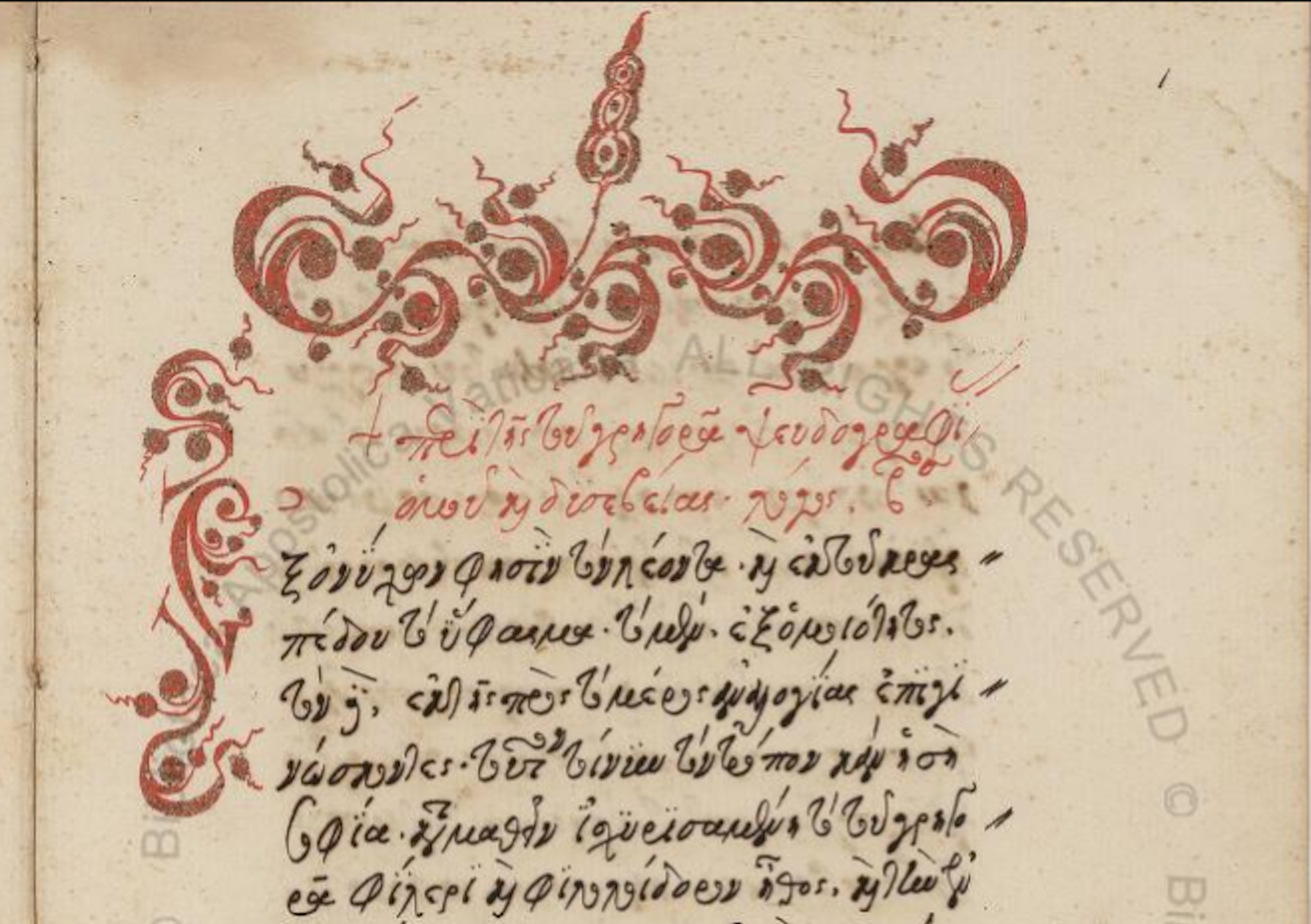
Gregory Palamas offers one of the most fascinating bridges between these worlds. In 1354, while travelling during the turbulent years of the Byzantine civil wars, he was captured by Turkish forces and spent about a year in captivity in Asia Minor, including Nicaea. During this period he wrote several letters to his flock in Thessaloniki, describing discussions with Muslim religious scholars as well as encounters with frontier communities whose beliefs reflected the complex interaction between Christianity and Islam in fourteenth-century Anatolia. These were not romantic tales of interfaith harmony, nor were they theological abstractions. They were real encounters taking place in a world marked by conquest, captivity, political upheaval and religious disagreement. Palamas remained firmly Orthodox and did not hide his theological differences, yet he approached these conversations with intellectual seriousness and genuine curiosity. His captivity reminds us that Byzantine hesychasm and Islamic spirituality did not develop in complete isolation from one another. They met in marketplaces and courts, on roads and frontiers, in prisons and cities, through debate, observation and human encounter.
Palamas’ theology is especially important because it helps us understand the icon as more than religious art. For him, God’s essence remains inaccessible but God’s energies truly communicate divine life. This distinction allows Orthodox spirituality to say that matter can shine with grace without becoming God. The icon does not contain God as an object. It participates, by prayer and ecclesial use, in a divine economy of presence. Likewise, Islamic calligraphy does not contain God in ink. It honours the revealed word and orders the eye toward tawhid, the oneness of God.
The icon and the calligraphic panel are therefore two answers to the same spiritual problem: how can the invisible be approached without being reduced? Orthodoxy answers through the sanctified image of the incarnate and transfigured person. Islam answers through the sanctified form of the revealed word. One sanctifies the face, the other sanctifies the letter. One says: God became visible in Christ. The other says: God spoke, and the word must be written beautifully. Both reject the merely decorative. Both distrust uncontrolled imagination, both transform art into obedience.
Their differences remain real and should not be dissolved. Orthodox iconography depends on the Incarnation and on the legitimacy of depicting Christ and the saints. Islamic sacred calligraphy depends on divine transcendence and on the primacy of Qur’anic revelation. But precisely because they differ, their kinship becomes more interesting. They are not the same tradition. They are two neighbouring grammars of reverence.
At their deepest level, both teach the eye to become humble. The icon asks the believer to see the human face as a possible bearer of divine light. Calligraphy asks the believer to see the letter as a vessel of divine speech. Both say that beauty is not luxury. It is discipline, theology and remembrance. The painted face and the written word become ladders. They do not replace prayer, they teach prayer how to see.