


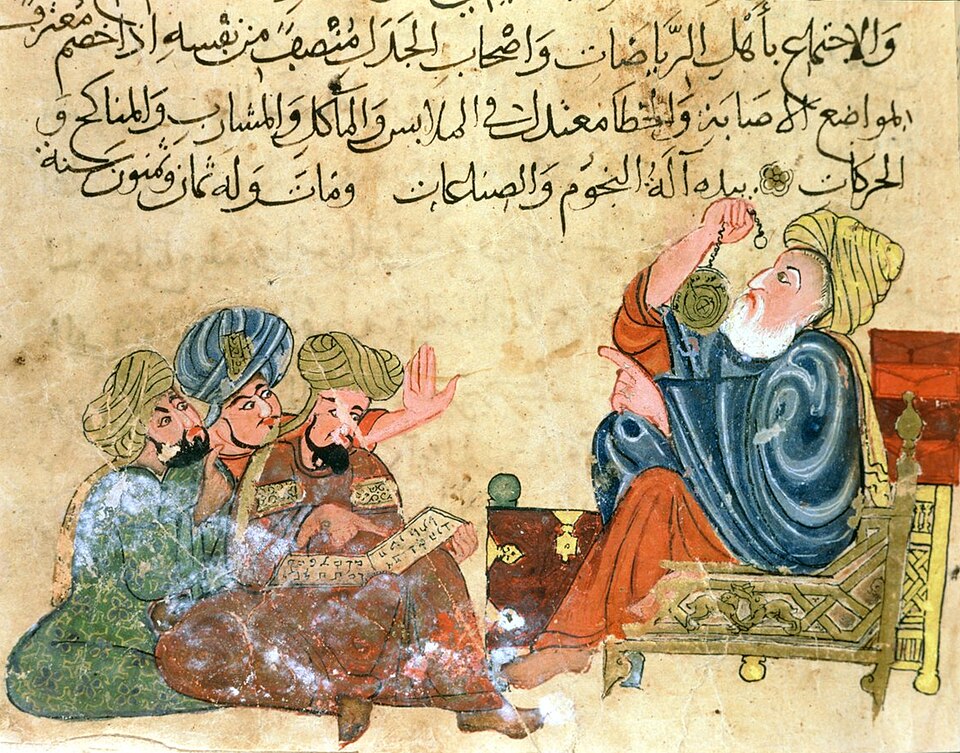
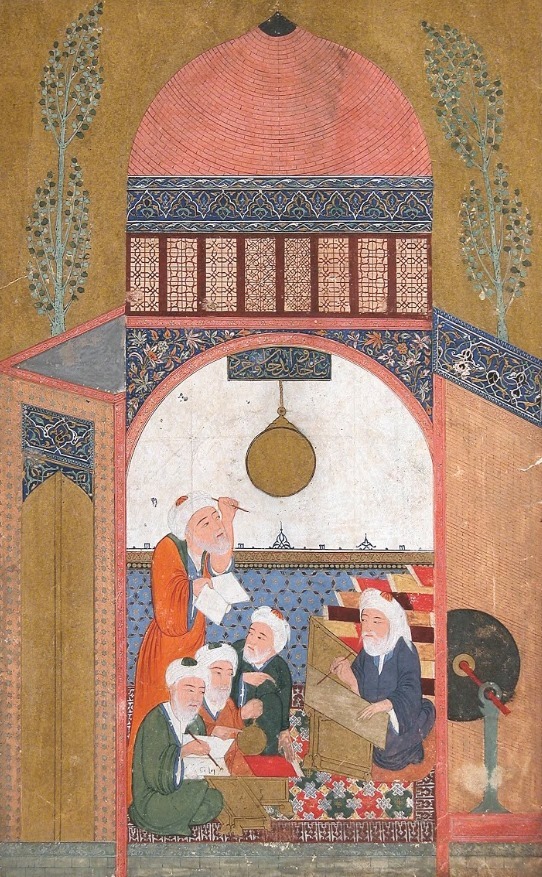
The night sky has always inspired science. The same happened in the Arab world more than a thousand years ago, when dozens of scientists gathered in the observatories of Damascus, Samarkand, Maragha, Baghdad, Istanbul and Cordoba to study the stars. And of course, no other celestial object was as closely associated with the Islamic civilization as the moon. The continuous calculations and observations of a lunar year (354 days) were essential for the determination of the most important religious ceremonies and practices.
In fact, the worship of the Moon is associated with primordial deities of the Arab mythology, even before the rise of Islam. In the Book of Idols by the Arab historian Ibn al-Kalbi (737-819), the three main goddesses of Mecca are presented: Al-lat (crescent moon), Al-Uzza (full moon) and Manaat (waning crescent). This triple form of the Moon is also found in several pre-Christian European tribes and of course in the Greco-Roman tradition (Hecate, Luna). The lunar crescent was a special symbol of Byzantine Constantinople, which was subsequently adopted by the Ottoman Empire.
However, the moon wasn’t the only star that fascinated the Arab astronomers, who named so many stars that 165 still bear Arabic names. The 10th-century Persian astronomer Abdul-Rahman al-Sufi was the first to mention the Andromeda galaxy —our neighboring galaxy— and called it “little cloud”. The star Denebola in the constellation of Leo comes from the Arabic word dhanab, meaning “the lion’s tail”. The brightest star in Taurus is the orange-coloured Aldebaran, named after the Arabic phrase for “the follower”.
Astronomy was therefore significant to the Islamic world. Astronomers helped build and operate mosques, taught in schools and madrasas, and advised rulers. It was Caliph Al-Ma’mum who began the tradition of building observatories for studying the stars and planets when he founded facilities in the Al-Shammasiyah quarter of Baghdad and on Mount Qasiyun in Damascus. And it was easier for early civilisations to observe planets and stars even with the naked eye as there were no bright city lights. Mercury, Venus, Mars, Jupiter and Saturn can be seen with the naked eye.
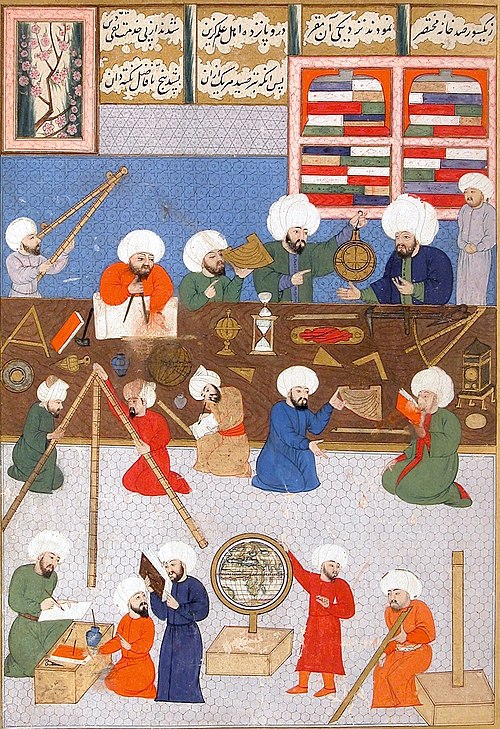
As the sky has order and logic, the astronomers attempted to predict the position of the sun and other stars by creating devices that reflected some celestial bodies and their orbits, such as celestial spheres and astrolabes. These models were constructed based on the perspective of the Earth. The astronomers of the Arab world inherited significant knowledge from the Greeks and the Mesopotamian civilizations, which they then improved, making calculations and predictions more and more accurate thanks to these devices.
For example, the astrolabe was the instrument used to detect the position of the sun and other celestial objects, a kind of primitive form of GPS. Practically, people used it to tell time day or night, navigate on land, and calculate sunrise and sunset. The construction of astrolabes, in fact, was a branch of applied science of great status during the 10th century. The scholar Ibn al-Nadim presents a list of 16 names of artisans of astronomical instruments and machines, including one woman, Al-Ijliya Al-Astrulabi from Aleppo. Al-Ijliya studied and followed her father’s science, distinguished herself for her craftsmanship, was hired and worked in the court of the ruler of northern Syria Sayf al-Dawlah.
Finally, the Islamic civilization made significant contributions to the world science leaving a legacy of precise observations and planetary models. Muslim scholars translated, made use of and spread earlier knowledge throughout the Arab-influenced world, acting as a bridge between the geocentric model of Ptolemy and the sun-centered model of Copernicus in Europe.